

Beyond Digital Fasting: Staying the Course
Our experience, your experience, and a call for photos


Until we have begun to go without them, we fail to realize how unnecessary many things are. We've been using them not because we needed them but because we had them.
- Lucius Annaeus Seneca
At the beginning of March we invited readers to join us on a Communal Digital Fast, an annual collective effort to restore our “human default”. At the end of each fast during the past two years, readers related their experiences, which we shared in Reawakening to the Freedom of Limits and How to Restore Rhythms that Make us Human.
For the first time during this Communal Digital Fast, we hosted live meetings: A conversation with Peter Limberg about The Pull & The 3Rs of Unmachining, and a discussion of all things books and Reading in the Digital Age with Joel J Miller, which you can listen to here:

The third and final meeting will be scheduled soon. Stay tuned for sign-up details next week!
In today’s post we’ll share our own experience during the fast, and we invite you to share yours in the comments below!
Peco’s experience
I spent much of Lent in the company of a criminal from St. Petersburg. And thinking about potato chips.
So here’s what happened. My goal was to fast from all digital news during the weeks of Lent, from March 3 to April 19, for a total of 48 days. I’m not usually addicted to anything online, except the news. There is something about political madness and frivolity that I find infuriatingly irresistible. At the same time, the point was not to just stop plunging into my screen to seek out the latest thwack-my-forehead headlines, but to spend more time reading novels, and so I decided to start with Dostoyevsky’s Crime and Punishment.
My wife, Ruth, is a regular reader of classic fiction, relishing lofty vocabulary and interminable sentences like alpine ski hills, riding down them with glee, whereas I just get exhausted, as if I’m scaling an endless ladder, wondering when it will ever end.
And as I plodded through Dostoyevsky’s novel, the screen pulled at me, whispered, tugged, tempted. What was happening in the news? I had no idea. Possibly, war had erupted, or some other cataclysm, but here I was, following an axe murderer through the streets of St. Petersburg, listening to his agitated ruminations. And all those names! Why do Russians have at least three or four different names? And everybody is either drunk, has tuberculosis, or talks in that peculiar 19th-century way, saying a great many things, while seemingly saying nothing at all.
And still it pulled, insisted—come, come, just this once! And not only the screen, but thoughts about potato chips. The problem was, I wasn’t only fasting from the digital, but, according to my usual custom during Lent, from meat, eggs, and dairy products.
Oh, and also coffee.
Never mind giving up digital news—coffee was the real problem. How could I feel stimulated without coffee? How could I feel anything? I didn’t even feel like myself. Why did I want to sleep half the afternoon? Why did all my goals and ambitions, which I had been so energetically pursuing before Lent, now seem kind of meh?
Great God, who was I?
The solution was potato chips. I don’t know how I discovered it. I think I opened a cupboard one day and saw the shiny bags (as any parent with teenagers knows, there is bound to be junk food stashed in obscure places). And I knew it was bad for me, and a kind of cheating, because the point of Lent is not simply to fast from a narrow range of things, but to maintain an overall spirit of fasting in everything.
So I restricted myself to eating only a small number of potato chips at a time, and often very slowly. When the chips ran out, I turned to salted peanuts, and if the peanuts ran out, it was walnuts. And all the while I’m still in St. Petersburg, following this axe murderer everywhere, although, strangely, the more time I spend with him, the more I realize he’s got a gentle heart, and is simply the victim of a delusional ideology.
Kind of reminds me of things I used to read in the news.
After a while, despite the potato chips, I noticed a change. The screen lost its grip on me. A kind of purity and energy entered my life. Although still mentally sluggish without caffeine, I could activate myself with a little effort, and slowly, gradually, regained momentum. The pull of the internet was still there, but it was easy to ignore, and soon I was discovering fresh energy in more reading, writing, and spending time with family.
Lent ended after a midnight church service and was followed by a late-night feast. There were over a hundred people, and a long table of meats and desserts of every kind—everything I’d been abstaining from for the past 48 days. I got to bed at 3:00 AM, slept in late the next morning, then made a big breakfast with a big coffee, with a laptop screen open in front of me, the latest headlines from CNN and BBC and Fox blazing brightly.
Then I thought, No, I’d rather not.
So I folded the thing shut, and started into a new novel.

Ruth’s experience
I spent my free time over the last seven weeks getting immersed in War and Peace, knitting a sweater, walking (until I broke my toe), and trying my hardest to stay within the digital boundaries I had set for myself. Not having a phone, it was always wonderfully freeing to be out of the house, relieved from all temptation that a laptop has to offer.
Like Peco, I also fasted from meat, eggs, and dairy — and coffee — and as the weeks passed, I found myself looking forward with great joy to the Easter feast. When it finally arrived, I appreciated with deep gratitude the flavors I had missed. In contrast, I had absolutely no desire to return to less restrictive internet habits again. I had not read the news for seven weeks, visited one site reluctantly, and knew instantly that I had not missed anything. The headlines seem designed for aggravation or outrage. Going forward news will stay off the menu.
Substack is the only social media platform I visit, mainly to read articles and connect with writers and readers. I fully admit that Notes can be entertaining, but it also reminds me of participating in a classroom full of eagerly raised hands waiting to be called upon. Having spent a few weeks without scrolling, I feel relief. Less noisy ants crawling through my headspace.
One day after the digital fast ended, I already recognize that my insights from the start of the year have remained true:
I am happier living in real time rather than getting lost in the digital time warp.
I don’t need or want to know everything.
I cannot offer anything of value if I spend too much time in the internet dimension.
The internet first leaves you with a high and then a hole.

The hard parts were the loopholes: I am writing online and need to find a reference and before you know it, I am engrossed in a comment section. A relevant article just got released, do I really have to wait until tomorrow to read it? An election has just been called, surely that should be an exception to my news reading?
Anyone who has a computer or other device will feel a pull, some more than others. The question is why we would choose to try and resist. It is effortful, why should we bother?
That gets at the core of a much deeper question. Do you believe that there is purpose and meaning in life? If so, do digital interruptions and compulsions interfere with fulfilling your purpose?
I believe we are created to be free, and this freedom is worth all my effort to fight for. Going forward I am committed to maintaining clear boundaries around my internet use. I recently offered this advice, which I plan to hold to myself:
Walk. Read. Create. Converse. Pray. Every day. It will restore your mind and ignite a hope that all is not lost in this world.

“The sugar high of convenience is fleeting and the sting of missing out dulls rapidly, but the meaningful glow that comes from taking charge of what claims your time and attention is something that persists.”
from Digital Minimalism by Cal Newport
Neither Peco nor I had any online presence before startingPilgrims in the Machine and School of the Unconformed. Writing about “offline life” online is an unavoidable oxymoron. We are keenly aware of skirting hypocrisy, but also recognize the unique opportunity of sharing practical ideas that have positive effects in people’s everyday lives. Yet any online social media platform has a toxic stickiness, no matter how great the people or the content. As long as there are likes, comments, and stats, we are bound to get ensnared.
The experience of the digital fast affirmed for us that we will stay the course by keeping clear internet boundaries in order to maintain and protect our cognitive liberty, our connection to each other and others around us, and living within our human default.
If we want to maintain our fast for the long term, then we need more than a rule about what we don’t want to do. We must work to change our rhythm and routines, which we discussed after last year’s fast in Sacred Synchronies: How to Restore the Rhythms that Make us Human.
Another decision that can help us stay the course, is creating a low-screen or screen-free home environment:
“Architecture for a Free Mind” - Call for photos!
A reader asked whether there is a resource that describes the interior decorating version of the “living unconformed lives in a digital age”, so we’ll be creating a visual guide!
Do you have a low-screen or screen-free lifestyle? What does your home look like? Do you have a room for books and reading? A room for arts and crafts? What does your workspace looke like? What fills your home instead of screens? Please send us your photos of living rooms, kitchen/dining tables, workspaces, bookshelves, gardens, etc. !
Send your pictures by replying to this note.
Please share with anyone who might have interesting photos to contribute :) Thanks to everyone who already sent in their pictures! Here’s a little taste:


Share your experience
Now it is your turn! Please share your responses in the comment section:
What was your experience of this year’s digital fast?
What practices worked for you? Did you discover any new strategies?
What was your biggest struggle?
What did not work?
Was knowing that others were fasting alongside helpful?
Going forward, are you planning on continuing any of your digital fasting practices?
There is still time…
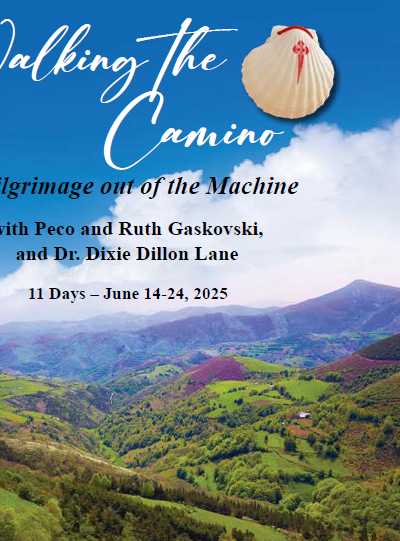
It’s not too late to join us on a walk of a lifetime! Come along as we walk the last 100 km of the Camino in Spain from June 14th to 24th. We’ll visit historic sites, travel along ancient Roman roads and through eucalyptus forests, enjoy delicious local fare, build relationships, converse, pray, and renew our mind and spirit. Everyone is welcome!
We’d love for you to join us! Register today to save your spot! See here for details and download the brochure below.
If you found this post helpful (or hopeful), please consider supporting our work by becoming a paid subscriber, or simply show your appreciation with a like, restack, or share.
