

A (Visual) Human Creed: How to Unmachine Your Life, the Universe, and Everything


For those of you who prefer to read off paper rather than the screen, we have converted the post into an easily printable pdf file.
You can tell an experience is powerful by what stays with you after it’s over. This is how we felt about the Doomer Optimism Gathering in Ligonier where we delivered a keynote speech. There were stimulating lectures and panel discussions on how to stay human in the machine age, ranging from Appalachian folklore and home economics to trades and transhumanism; and there was food, conversation, laughter, families, toddling babies and scampering children, high-brow debates and comic debates, spontaneous barn-dances, all in a cozy meetinghouse amid the sun-burnished hills of the rust belt. It was wonderful. But what we most appreciated were the real-world connections that we made with other people, and the energy and hope we took away when we left.
As Substackers with a digital presence, we were especially moved by the people who made their way from far-flung places (one couple even flying in from California!) to connect in person. This was more meaningful than tens of thousands of “followers” or “likes”. The gathering affirmed to us that it’s when ideas are incarnated that they reveal whether they hold mere vibes or true value. Phones were rendered utterly irrelevant as we collectively experienced the joy of pure presence.
We began our talk with an anecdote about a fierce winter blizzard that enveloped us in St.John’s, Newfoundland. The year was 2006, before the first iPhone, before social media had like buttons, and long before AI. We had no idea what was coming. Another blizzard was coming, this time a worldwide digital storm. And just as we couldn’t fight a blizzard with a shovel, this new storm could not be fought with small isolated strategies.
It would demand a different approach, an approach that for us developed organically over two decades of experience as a family, and it’s what we want to share with you here.
The Visual Human Creed - by Peco
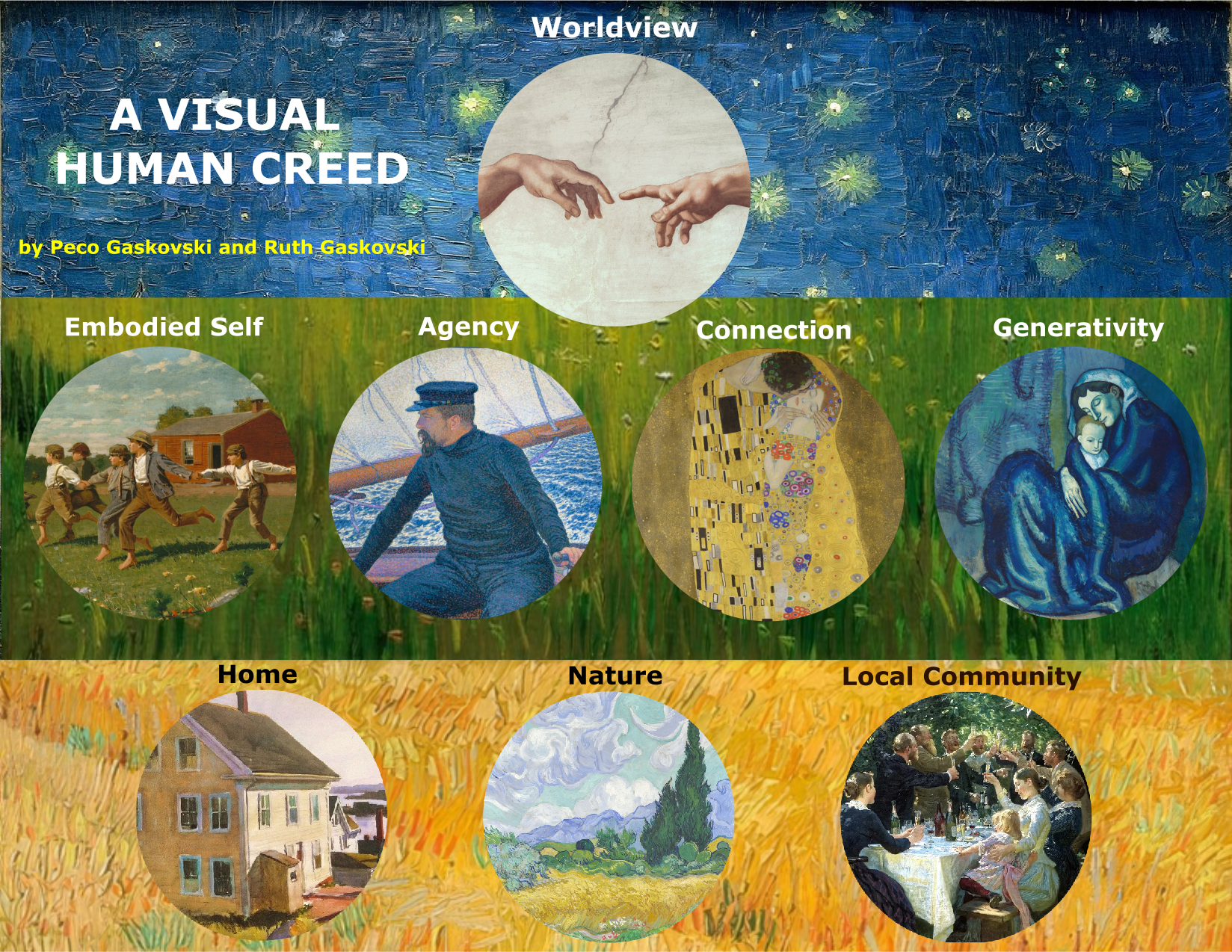
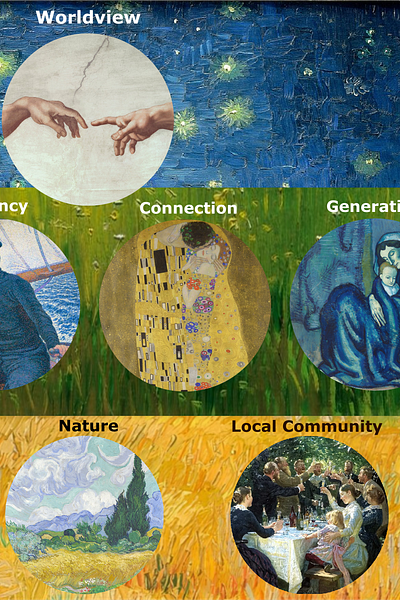
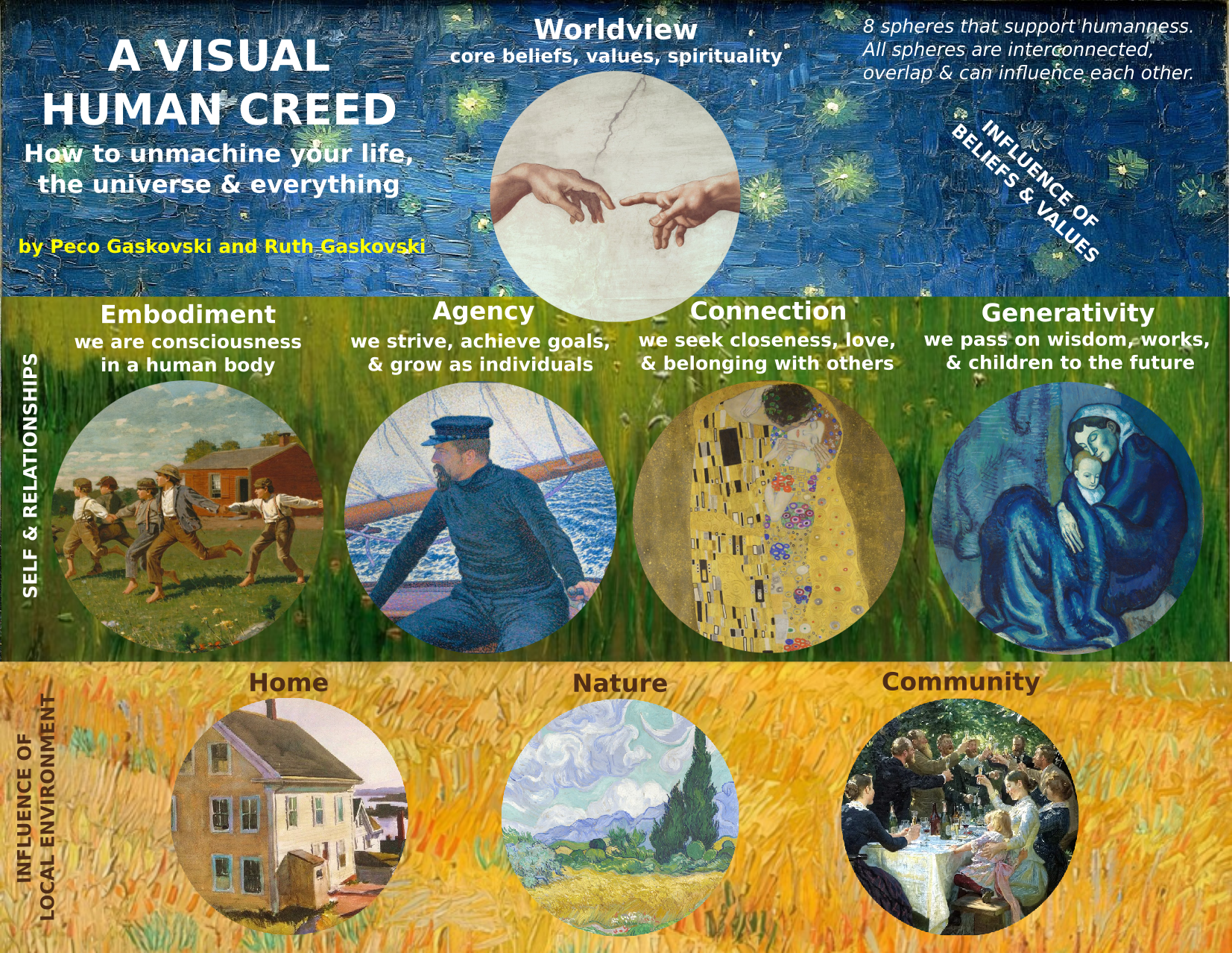
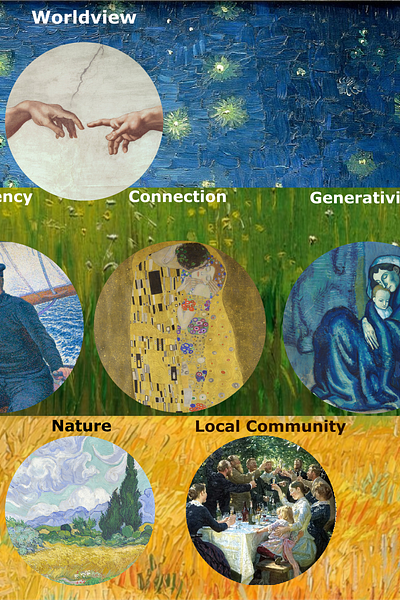
The graphics below depict the eight spheres of the “Visual Human Creed”, including: worldview, embodiment, agency, connection, generativity, home, nature, and local community.
These eight VHC spheres of life, in our experience, contribute to what it means to be human. All of the eight spheres of humanness are interconnected and can influence each other, and they are ultimately inseparable.
We don’t pretend this is a complete description of what it means to be human, but it does cover many of the practical domains of life that tend to come up in “Machine” and technology conversations.
We have created the VHC to encourage a clearer language for discussing the impacts of technology, and for how we might safeguard and develop those aspects of life that are central to our humanness.
At the Doomer Optimism talk in Ligonier, we had an opportunity to explore each of the spheres during a one-hour lecture. In today’s post we’ll touch on one of those spheres—Worldview—along with some practical principles.
Note: We were delighted to meet many readers in person, but recognize that it’s impossible for everyone to attend these meetings live. We have thus created an audio recording of our entire keynote address for our paying subscribers. Until November 30th, we’re happy to offer a 20% Doomer Optimism discount for new subscribers!
You can access it here: Doomer Optimism Gathering Keynote Address: A (Visual) Human Creed. (If you are a Pilgrims in the Machine subscriber, you can access it here).
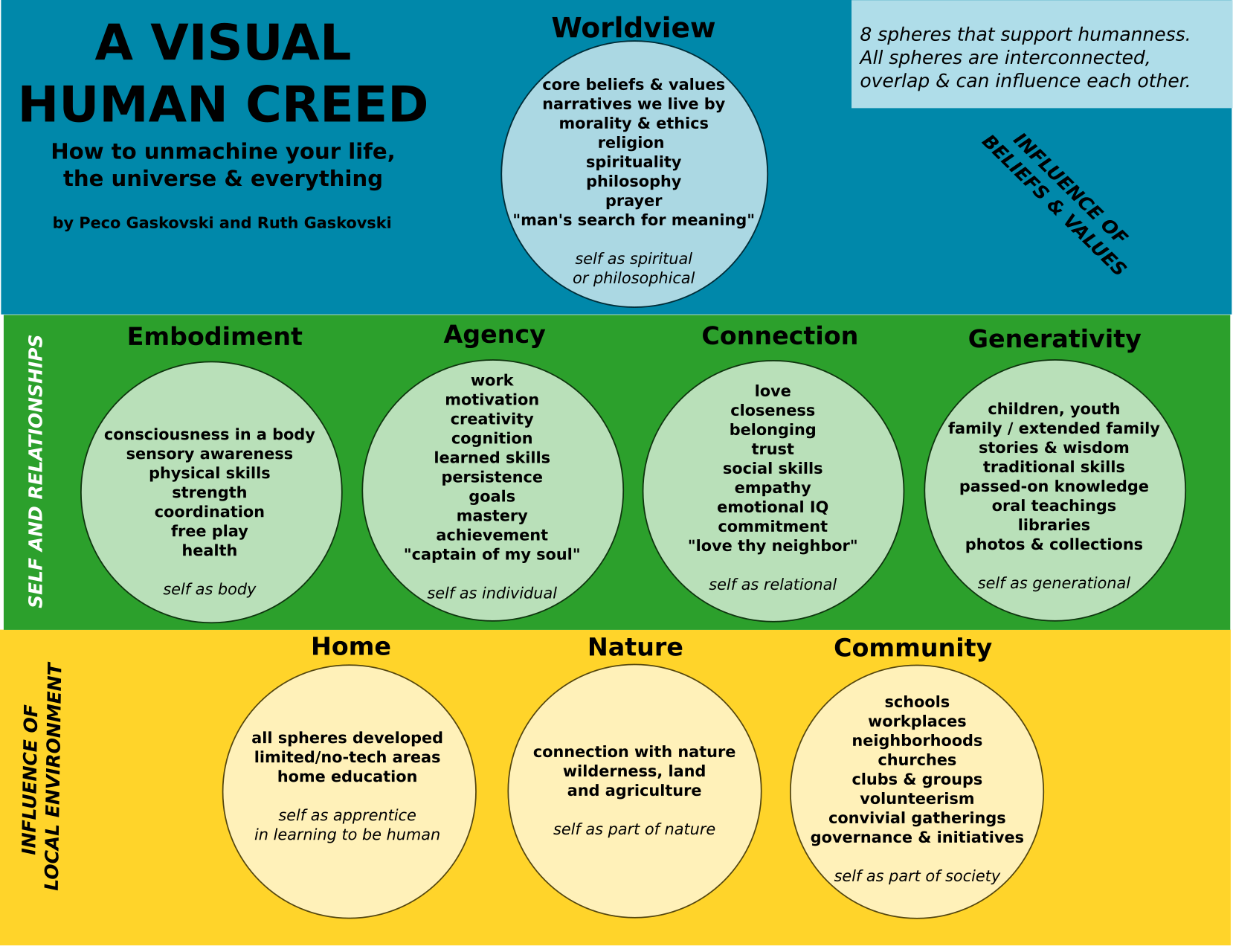
The second graphic below offers more insight into the specific areas subsumed within the spheres:
Copyright: Feel free to use the Visual Human Creed graphics for reposting, discussion, or teaching, but please give copyright credit to “Peco Gaskovski and Ruth Gaskovski” and link back to this article.
The Puzzling Game - by Peco
Pleased to meet you
Hope you guess my name,
But what’s puzzling you
Is the nature of my game.
These lines are from the Rolling Stones’ classic hit, Sympathy for the Devil, released in 1968. If you’ve never heard the song, it’s the devil singing about all the terrible things he’s done, and he’s asking you to guess who he is and what he’s up to, even though it’s totally obvious. He’s making a mess of the world.
Sometimes I feel that way about digital devices. We know our devices can be associated with harms, yet we still get drawn into the game.
And we know, of course, that what we experience on our screens can manipulate our values, and our view of the world. G.K. Chesterton said that “the most practical and important thing about a man is still his view of the universe”. Chesterton is right. Worldview is powerful. Our deepest beliefs shape our everyday thoughts and feelings. They can make us depressed or joyful, can make heaven seem like hell, or hell seem like heaven.
Worldview can be a religion, or even just a set of core values you live by. Whatever it is, it’s your steering wheel for life, guiding your direction and your actions.
Worldview is one of the few things in life we can freely choose. You can’t choose your genetics, where you were born, your parents. But you can choose how you think. You can choose how you think even in the worst of conditions.
During World War II, philosopher Jean-Paul Sartre observed that German-occupied France was never more free, because “every accurate thought” was a conquest over German propaganda. Here’s what Sartre said in 1944:
We were never more free than during the German occupation. We had lost all our rights, beginning with the right to talk. Every day we were insulted to our faces and had to take it in silence. Under one pretext or another, as workers, Jews, or political prisoners, we were deported en masse. Everywhere, on billboards, in the newspapers, on the screen, we encountered the revolting and insipid picture of ourselves that our oppressors wanted us to accept. And, because of all this, we were free. Because the Nazi venom seeped even into our thoughts, every accurate thought was a conquest.
That last phrase will always be true. Every accurate thought is a conquest.
And yet today, in the Machine age, what threatens our ability to think accurately is often different from the threat in Sartre’s time. Our devices are certainly capable of spewing venom; but they also spew a type of vanity.
And this distorts our worldview in ways we don’t always notice.
As a psychologist I have a small therapy practice. A key part of therapy is helping people see how their beliefs might be distorted or inaccurate, and to help them develop more accurate beliefs.
For instance, a client might believe themselves to be worthless or unlovable, yet may discover those beliefs are inaccurate, if they have experiences in the real world that correct their view of themselves.
This isn’t only true for therapy clients, but all of us. Distorted beliefs can get corrected through experiences in life.
The limitation of the digital world is that it isn’t directly connected to the real one. There’s no earth and soil behind our screens, no raindrops falling, no tree roots sucking up moisture, no muddy footsteps made by human feet. It is a digital representation, a shadow mimicking reality.
This separation from the real gives the online world a certain latitude, a certain stretchiness. Say I see this article on social media, then I hear a really interesting podcast on the same subject, and suddenly I’m convinced it’s true: Twinkies last forever.
Or somebody in a morgue accidentally cremated his coworker.
Or maybe I come to believe the Holocaust didn’t happen, or that actually—well, you get the idea. Digital reality allows us to stretch our worldview in extreme ways, and as long as it holds together and seems internally consistent, we might believe it. Philosophers call this the coherence theory of truth. I’m a novelist as well as a psychologist, and I can tell you, this is how you write fiction. My stories are not true. They’re completely false. They’re believable only because they’re coherent. If I’m writing a tale set in Victorian England, I know I need horse-drawn carriages, men in top hats, women in love with men in top hats, ballroom dances, and hapless vicars. But I can’t have drones flying around, because that would shatter the internal coherence of the narrative.
Unless, of course, it’s a fantasy story, in which case it would be coherent.
But online experiences can coddle our view of the world, even if it is fantasy. This happens not just because people are trying to spread “fake news”. It happens because we have an urge to make sense of the world we live in. But digital content, being so easy to manipulate, can turn the search for real understanding into a search for whatever satisfies us.
So we can end up with blancmange understanding, like a blancmange pastry: a high-sugar trans-fat blob of tasty ideas, without much basis in fact, and with no great nutritional value.
Such distorted ideas become possible because they remain separated from the corrective friction of reality. It will always be easier to stay in the virtual world and keep our distortions, because there, they seem to cost us nothing. Except maybe truth.
And what is truth?
What is truth? is also the question that Pontius Pilate asks shortly before sending Jesus to be crucified. It’s a very modern question, but it’s fitting that it was asked by a Roman, because it shows it’s also an eternal question. What is truth? How do we know that we aren’t all living in a dream right now?
Before the crucifixion, Jesus is scourged, leaving him wounded and bloody before the final execution. Jesus is supposed to be God, this infinite power “out there”, but at that moment in the story, he is embodied in physical reality. Even if you are not a religious person, there’s something here that speaks to a question we face in our age.
You see it in the Book of Genesis too. Let there be light. Let there be land. Let there be creatures. God speaks, and words become physical reality. According to this worldview, reality is not a dream, not a virtual simulation. Our consciousness is connected to a body and a physical world where there are aches, sufferings, and even death, but also the beauty of summer skies, raindrops, and the feeling of mud under our feet.
If, as Sartre suggests, every accurate thought is a conquest, then every embodied experience can support that conquest through the corrective friction of life itself.
So why don’t we seek that out?
Partly because the corrective friction can be painful. I wouldn’t wish suffering on anybody, but suffering is one of the few experiences that forces us to ask, What is my life, the universe, and everything all about? It’s the big why? When suffering asks the big why, it demands an answer—and this answer could help us build a more meaningful worldview.
Our screens are a way of avoiding these vital existential moments.
Pleased to meet you
Hope you guess my name,
But what’s puzzling you
Is the nature of my game.
The game remains puzzling because it will always be easier to live through distorted cognitions, whether their source is our own fantasies, or media or social media, or even foreign countries that flood the internet with corrupt AI chatbots that spread lies. Everybody is playing the puzzling game, from the preteens with smartphones to the hostile dictators with armies of hackers.
In WWII Sartre was oppressed by Nazi propaganda, but at least he could tell the difference between good and evil, between the accurate and the inaccurate. That is not our situation. What oppresses us is a thing that we can shape and reshape in the palm of our own hands like plasticine. It’s not Nazi propaganda, it’s play-dough propaganda: cheap, widely available, easy to use—and you can make anything with it.
It’s not just that the content in our minds can be distorted. Our very mental processes are at risk. A recent study showed that people who shared an extreme political ideology had synchronized neural responses in the brain. But not only that:
Those who shared an extreme perspective — even when they did not share an ideology — exhibited increased neural synchronization.
To be clear, it didn’t matter whether people were extreme liberals or extreme conservatives. The same brain regions were doing the same thing.
These are the sort of people who might fervently argue with each other on social media, based on opposing worldviews, oblivious to the fact that their perspective, in a deeper sense, is identical. They are oblivious to the puzzling nature of the game, they get so caught up in the play-dough propaganda, that they fail to realize the ultimate purpose of the game: to turn their minds into the play-dough.
We’ll never be able to build an accurate and lifegiving worldview out of stretchy digital goop. But we don’t have to play the puzzling game, not if we’re determined to seek out the corrective friction of the real world—through our embodiment, agency, connection, and the other spheres shown in the Visual Human Creed.
More than 20 years ago, before a worldwide digital storm swept over our lives, my wife and I made a lot of mistakes—and this happened not by accident, but because we chose a worldview that encouraged our self-interest above all else.
It almost destroyed our family. That’s a whole other story.
But the suffering we went through jolted us into wakefulness, and caused us to rethink our core beliefs about life. We became people of faith because once you almost destroy the things you love, once you glimpse how deep the darkness goes, it can make you really desire the light.
This is where we found our conviction for why we needed to resist the Machine. We can’t give you our conviction. But we all need a worldview that inspires us toward a higher and more humanizing vision of life.

From Moving Mind Furniture to Action - by Ruth
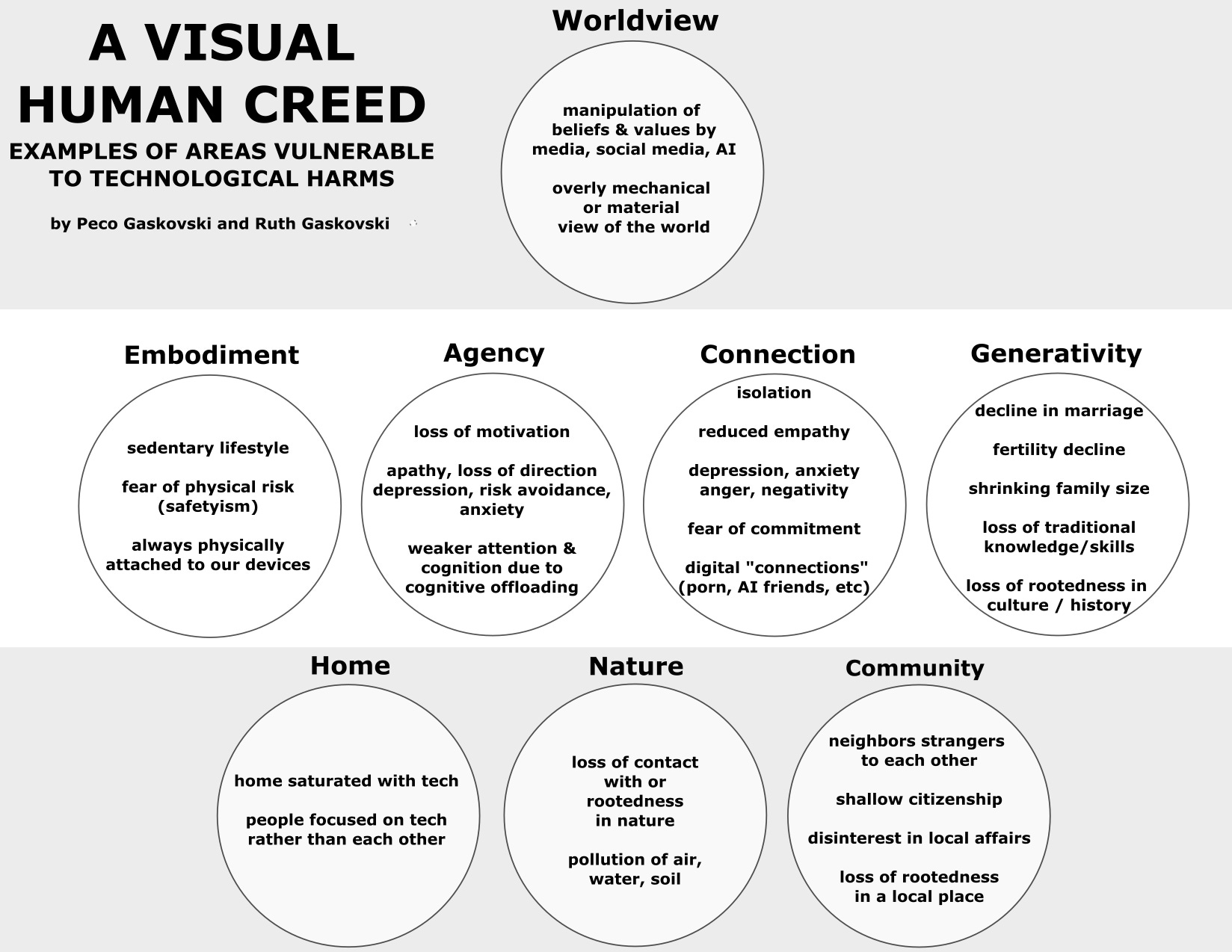
All of the spheres that make up the Visual Human Creed are impacted by digital technologies, so much so that it can be difficult to recognize who we are without them.
If the internet turned off tomorrow, would we be a mere shell?
In the graphic below, we highlight some of the areas that are vulnerable to tech harms:
But these are not news.
The question is, how do we respond?
In the 3Rs of Unmachining, Peco and I proposed three steps: Recognize, Remove, Return. Recognize the damaging impact of technology wherever it happens, Remove it, and Return to the real world. If we get stuck in just recognizing the damaging impacts, nothing changes.
We can read as much Mumford, Kingsnorth, Crawford, Berry, Newport, Carr, Haidt, or any number other tech-critical writers as we will, but if all these insights do not actually translate into our lives, we are only moving mind furniture.
G.K. Chesterton sums it up perfectly: “I do not believe in a fate that falls on men however they act; but I do believe in a fate that falls on them unless they act.”
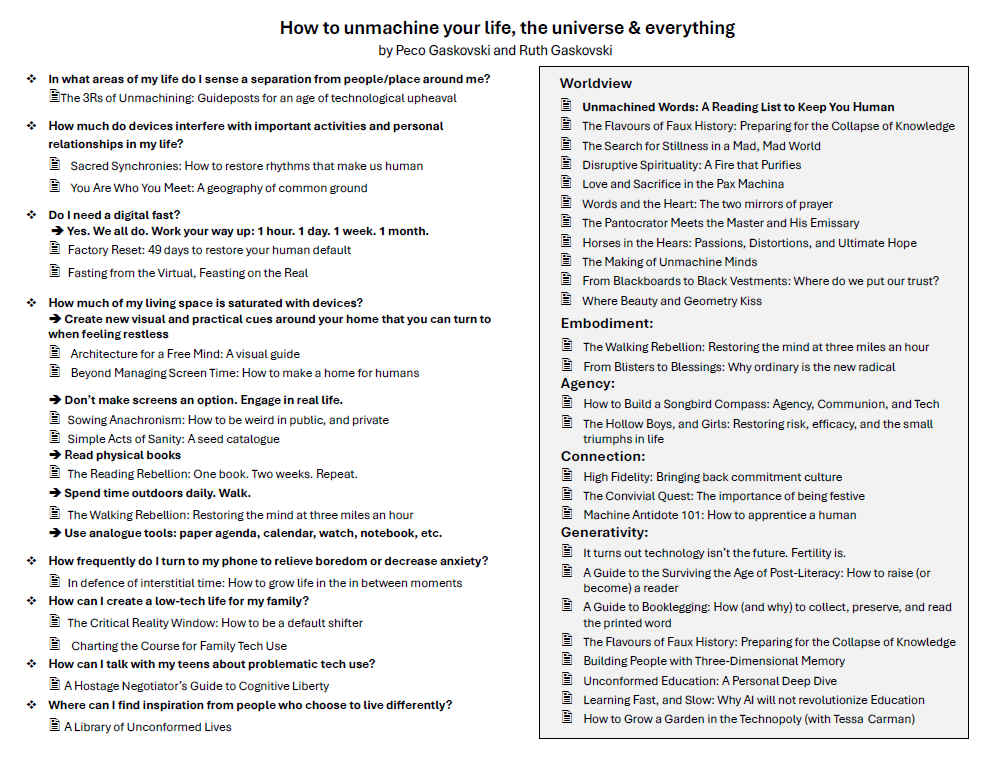
Below you’ll find some questions for reflection, as well as articles that we have written in relation to each topic that help offer practical, actionable starting points:
And we don’t have to act with the expectation of impending doom. A priest who recently visited Mount Athos told us about a monk there who was lamenting how technology had even reached their monastery. His listeners were dismayed. He went on to talk about more terrible things technologies had wrought, and they nodded in gloom. Then someone asked, “But what are we to do?”. He thought briefly the replied, “What are you to do? REJOICE!”
So we must commit to action, joyfully.
If you have not done so already, it is helpful to start with a digital fast. A period of abstinence from our screens helps us rediscover who we are outside the context of our devices. During our Camino pilgrimage in Spain this summer, I spent 0 minutes on the internet, read 0 news articles, and I can’t begin to tell you how wonderful it was to recover a mind that is simply and fully present.
A digital fast can also help us decide what technologies we actually need. Do you need a smartphone, or is a flip phone just fine? Our 17-year old just got his first flip phone, and he mostly forgets it at home. Whether you take on a week or a full month of a digital fast, it can feel daunting. But all it takes is some planning, perseverance, and a some healthy self-denial. And you will be surprised, how much extra time you suddenly have.
We hold a yearly communal fast during Lent, because it can be helpful to know that others are trying alongside you. But you can really start a fast any time. You can begin by reclaiming the interstitial moments of your daily life. Or join the Reading Rebellion, One Book. Two Weeks. Repeat. Turn your daily scrolling time into reading time instead. Or join the Walking Rebellion, committing to a daily 20 minute walk. There is nothing quite like walking to restore your mind.
These are just some of the starting points that help move us toward an unmachined life.
When we think of the Machine it may feel as if we are facing an immense, ominous force. The image is well captured by a somewhat apocalyptic dream I had a few years ago, of a towering black tsunami wave that was about to come crashing down. Except it was not made up of dark waters but a mass of 0’s and 1’s, a digital deluge.
While I was reading War and Peace over the past few months, I was struck by the analogy of a similar force that the Russians faced in 1812 when they were up against the French army. It too seemed massive and invincible. Napoleon marched his army into Russia, and he was victorious, winning almost all the battles.
But he loses in the end.
It’s not the Russians who defeat him, but the Russian winter. Napoleon has this huge fighting machine, but the machine has no relationship to the place it is in. It is made up of men. Men who go hungry and who freeze and who lose morale and who die.
His war machine can’t survive. This is true of the kind of machine we are facing today.
When technology separates us so profoundly from each other and the real world, it has created within it the seeds for its own downfall. The Machine lacks agency, it has no generativity, it does not produce life, and so it’s ideas are bound to die. We don’t need to fight it directly.
What we need to focus on is how to live a fully human life. The individuals and families who commit themselves fully to remaining grounded in reality, and on being fully human, have already won the war.

Principles of the battleground - by Peco
You can think of the eight spheres of the Visual Human Creed as battlegrounds for what it means to be human. Fortunately, in this fight, you don’t need to defend all eight battlegrounds.
At minimum, all you need to do is defend one.
Defend even one sphere thoroughly, and you will save many of the others. If you radically cut back on screen time because it interferes with agency, you’re not just helping preserve your agency, but other aspects of life, like relationships.
So, while we may be discussing the spheres separately in our writing, in reality they are all interconnected. There aren’t eight battlegrounds, but a single reality of what it means to be a person.
Ruth was just talking about Napoleon’s defeat, and I’ve used the word battleground, and we’ve chosen these metaphors deliberately, though not because we are urging you to some kind of militancy. Rather, it’s to point out that there is no neutral ground. There can seem to be, as we can look around and say, Things are peaceful. It’s not like we’re in Tolstoy’s novel and musket shots are flying around us through the smoke and mist.
In a visible battle, you fight or you flee because you want to survive. In a visible battle you can see, with alarming clarity, that danger is near, and to sit around doing nothing is a luxury you don’t have.
But we can often convince ourselves we have that luxury, and this a disadvantage, because it can lull our conviction that we need to take action to safeguard our humanness.
One of the principles that has guided us is, enjoy the peace and abundance of your life, and share it. But don’t turn off your inner radar. There is an ongoing battle, not a physical one, but one that wants to manage, manipulate, or monetize your cognition, emotions, relationships, home environment, and even—and maybe especially—your children, who are the future.
And the technologies that do it can feel convenient and comfortable, which is why we keep losing territory in the battle. So get a good radar, and keep it on—quietly in the background—and never assume there’s no battle, or that you’re actually on neutral ground.
We can’t do it alone, either. We need to be in committed human relationships. This is what leads to friends, having people you can count on and trust, marriage, children, and new generations. We highlight the importance of relationship not because we’re thinking, Hey, let’s build a new society or counterculture, because that’s putting the cart before the horse. The point is that committed relationships are intrinsically essential to being human. And if you never practice commitment in relationships, you probably won’t get far in building a new society or counterculture.
And while we need a good radar, the guiding principle should not be that we are against things. We do not need to be reactionaries or activists. That doesn’t mean don’t have strong feelings. There are certain forms of technology and techno-centered values that we utterly reject—viscerally and daily. But being against things, as a guiding principle, is not how to build a life. It’s a way of staying frustrated. It puts your mind in a negative frame of expectancy, which not only makes you more prone to seeing negatives, but narrows your attentional focus, making it harder to see positives and opportunities that might be right in front of you.
The way to build a life is to focus on those most defining aspects of our humanness—our capacity for love, our power to develop ourselves as individuals, and the other areas we’ve talked about. These things can be squashed and distorted by the bulldozing of technology; but they are also the enduring wildflowers that will always sprout through.
Our task is to plant the seeds. To focus on what we want to be for, much more than what we are against.
The armies of Napoleon have arrived. The great forces of the Machine are all around us. But you don’t have to fight them directly. Winter is coming, and to survive a winter you need people close to you, faith in your purpose, and a willingness to take care of the tiny piece of land beneath you. So plant the seeds.
Now, maybe that will grow into a counterculture? Or maybe a parallel society, or just a thriving subculture inside an existing society? It’s hard to predict. There are too many variables.
But sow the seeds, tend them daily, and something good and beautiful and true will grow.
Because true things don’t die.
We are happy to offer this post to you for free, but it took a lot of time and effort :) If you found this post helpful (or hopeful), please consider supporting our work by becoming a paid subscriber, or simply show your appreciation with a like, restack, or share.
Until November 30th, we are offering a Doomer Optimist 20% discount!
We’d love to hear from you! Please share your questions, thoughts, and reflections in the comments section!
Further Reading
If you’d like to gain some further insights into what happened at the Doomer Optimism Gathering, these posts offer additional reflections (the first one is by our daughter) :
A Journal Entry from Ligonier by Maia Ellie
Being human together by Grant Martsolf & The Savage Collective (includes reflections from several attendees)
Love Hopes all Things by Dominick Baruffi
The talks presented at the event were, to put it mildly, outstanding….These were not highbrow academic talks given to impress the academy. These were practical takedowns of the realities of Machine culture, a call to retrieve the essence of what makes us truly human. Plus, given many of the presenters also happen to have a presence on this platform, the result was “Substack in the analog;” trust me, the intellectual rigor we saw on display would put academia to shame.
Believing Something, Believing Someone by Jane Gross for The Savage Collective
Ruth and Peco Gaskovski were an embodied inspiration to me at the event. Their writing has given me practical tips for creating a low-tech, highly relational environment in my home, but their family dynamic confirmed the fruit of their wisdom. I met them face-to-face. I encountered their warmth and the laugh lines by their eyes, and saw their teenage children engage adults with thoughtfulness and poise. This all substantiated my impression that they are people I trust and will return to for parenting advice. I believe what they say because I believe them.
Doomer Optimism Magic by Ashley Fitzgerald and Doomer Optimism
Doomer Optimism + Savage Collective Conference by Jeff Caldwell
Love in the Machine Edition by j. elliot
The Work of the Last American Worker by Oliver Bateman Does the Work